There is a familiar moment that occurs in many complex engineering programs.
The modelling appears sound. Reliability predictions are within target ranges. Availability forecasts are strong. Maintainability calculations satisfy program thresholds. Confidence across the review environment is high because the numbers appear coherent, traceable, and technically defensible.
Then the system enters operational service.
Within months, availability begins drifting below expectation. Repair times extend beyond planning assumptions. Fault isolation proves slower than anticipated. Supply support becomes strained. Maintenance activity consumes more labour hours than originally modelled. Operational workarounds emerge quietly to compensate for sustainment friction that had not been fully visible during development.
Often, no single engineering failure can be identified.
The system may still satisfy its functional requirements. Components may technically perform within specification. Analytical models may even remain mathematically correct according to their original assumptions.
Yet the operational outcome diverges from the prediction.
This pattern is not unusual in defence, rail, mining, infrastructure, and other long-life operational environments where system performance depends not only on technical functionality, but on sustained operational availability across years or decades of service.
The underlying issue is frequently less about analytical capability than engineering posture.
Reliability, Availability and Maintainability are often treated as modelling activities performed around a design rather than as integrated engineering disciplines shaping the design itself.
That distinction carries significant operational consequence.
Availability Is a System Property
Operational availability does not emerge from reliability calculations alone.
It is produced through the interaction of architecture, maintainability, diagnostics, supply support, environmental suitability, sustainment strategy, operational usage, workforce capability, configuration control, and lifecycle decision-making over time.
Availability is therefore not merely a reliability outcome. It is a system property.
This distinction matters because engineering programs often approach RAM activity as though availability can be validated analytically near the end of the development cycle once the primary design has already matured. Reliability allocations are established. Mean Time Between Failure values are calculated. Maintainability assumptions are inserted into models. Availability projections are generated for governance review and contractual demonstration.
At that point, however, much of the operational reality has already been embedded within the architecture itself.
Redundancy philosophies have been selected. Equipment layouts have been fixed. Access paths have been constrained. Diagnostic capability has been defined. Environmental assumptions have been accepted. Maintenance concepts have been shaped, whether deliberately or implicitly.
The calculations do not create those conditions. They simply quantify the consequences of decisions already made.
This becomes particularly important in complex operational systems where availability degradation rarely originates from a single catastrophic design flaw. More often, it emerges gradually through accumulations of friction across the sustainment environment.
Repair activity takes longer than expected because accessibility was treated as secondary to packaging efficiency. Fault isolation becomes difficult because diagnostic philosophy was underdeveloped. Spare demand exceeds forecasts because operational usage profiles diverged from laboratory assumptions. Maintenance burdens increase because environmental exposure accelerates wear mechanisms that were not adequately represented during modelling.
Individually, these issues may appear manageable.
Collectively, they shape operational availability far more than a spreadsheet alone ever could.
The Limits of Spreadsheet Reliability
Reliability modelling remains essential engineering work. Quantitative analysis provides necessary visibility into expected failure behaviour, sustainment demand, logistics burden, and operational risk. Without modelling, engineering decisions become reactive and intuition-driven.
The problem is not the existence of RAM modelling.
The problem emerges when modelling becomes detached from operational realism.
There is a tendency within some programs to treat RAM primarily as a reporting requirement. Reliability metrics become contractual deliverables. Availability figures become governance artefacts. Mean Time Between Failure calculations become indicators of engineering maturity regardless of whether the underlying assumptions remain operationally credible.
Under these conditions, modelling can become descriptive rather than influential.
The engineering question subtly shifts from:
“How do we shape the system to achieve sustainable operational availability?”
to:
“How do we demonstrate compliance against the required metrics?”
The distinction is significant.
A mathematically coherent model can still produce operationally misleading outcomes if the assumptions embedded within it fail to reflect real operating conditions. Supplier reliability data may be generated under controlled laboratory environments with duty cycles, thermal loads, contamination exposure, vibration profiles, or maintenance conditions substantially different from operational reality.
Field environments rarely behave like qualification environments.
Mining systems encounter dust ingress, vibration, and continuous operating cycles that accelerate degradation beyond nominal expectations. Rail systems operate under fluctuating environmental conditions and constrained maintenance windows. Defence platforms experience unpredictable operational tempo, intermittent usage patterns, and environmental exposures difficult to replicate during controlled testing.
Even relatively small deviations between assumed and actual operating conditions can significantly alter failure behaviour over time.
Without mission-profile-based analysis and continuous operational feedback, reliability figures can create a false sense of confidence detached from the conditions the system will actually encounter in service.
This is not a failure of mathematics.
It is a failure of engineering integration.
Maintainability Is Designed Into the System
Maintainability is often discussed conceptually during development while receiving comparatively limited influence over physical design decisions.
Yet maintainability frequently becomes one of the dominant drivers of operational availability once systems enter service.
There is a substantial difference between a component that is theoretically replaceable and one that is operationally maintainable within realistic field conditions.
Engineering models may assume a Line Replaceable Unit can be exchanged within ninety minutes. The maintenance procedure may appear straightforward within documentation. Tooling assumptions may appear reasonable in workshop environments.
Then the first operational repair occurs.
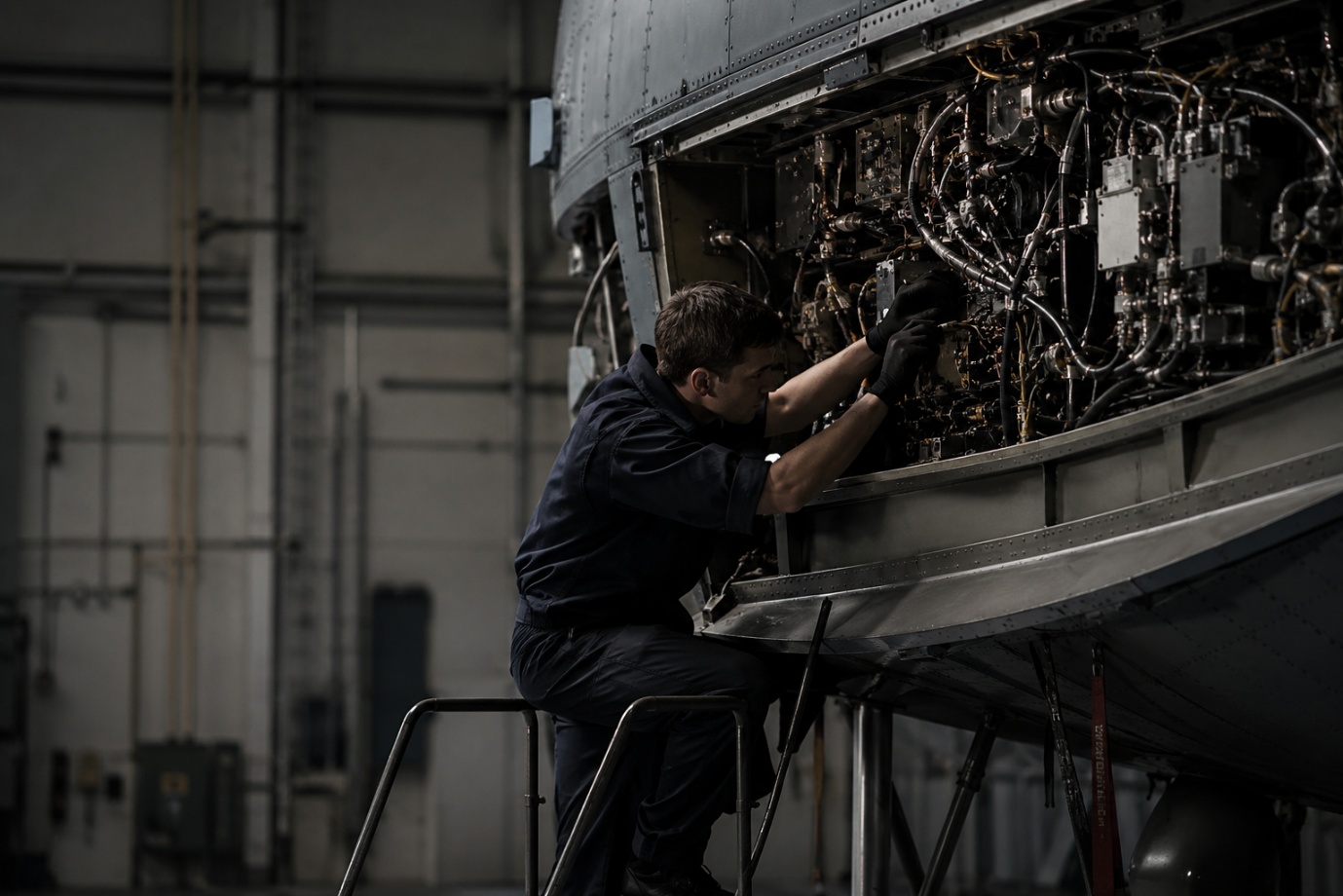
Structural panels require removal before access is possible. Harness routing obstructs extraction paths. Adjacent assemblies must be disconnected to reach the failed component. Fault isolation consumes hours before replacement even begins. Environmental conditions complicate access further. Reassembly and testing extend well beyond planning assumptions.
The issue is not that the maintenance calculations were incorrectly performed.
The issue is that maintainability had not been treated as a primary design variable early enough in the design process.
Accessibility, human factors, diagnostic visibility, tooling requirements, and maintenance sequencing all influence operational availability directly. Yet these elements can remain underrepresented within early architectural trade studies where performance, weight, packaging, cost, or schedule pressures dominate decision-making.
Once embedded physically into the system, these constraints become expensive to reverse.
As a result, operational maintenance activity often reveals the practical reality of design decisions more honestly than development models ever could.
This is one reason availability performance cannot be understood purely through reliability metrics. Systems with comparatively strong reliability may still underperform operationally if maintainability assumptions prove unrealistic. Conversely, systems operating with higher failure frequencies may still sustain acceptable availability when maintenance pathways, diagnostics, spare provisioning, and repair workflows have been engineered effectively.
Availability emerges from the interaction between failure behaviour and recovery capability.
Both must be designed deliberately.
Sustainment Begins During Design
One of the more persistent structural separations within engineering organisations is the distinction between design engineering and sustainment engineering.
Design teams focus on functionality, integration, certification, and delivery. Sustainment functions become engaged later to address logistics support, maintenance planning, provisioning, technical publications, and operational support structures.
In practice, however, sustainment performance is heavily shaped long before operational service begins.
Architecture determines maintainability constraints. Software structures influence diagnostic capability. Supplier selection affects obsolescence exposure and spare supportability. Environmental assumptions influence degradation patterns. Access decisions affect maintenance labour burden for decades after acquisition.
Sustainment is therefore not downstream of design.
It is embedded within it.
This becomes particularly important when programs optimise heavily around acquisition cost without adequately accounting for lifecycle consequence. Lower upfront procurement cost can create substantially larger operational burdens over time if reliability, maintainability, repairability, or supportability assumptions prove weak in service.
A cheaper component may reduce acquisition expenditure while simultaneously increasing spare holdings, maintenance labour, operational downtime, and supply chain dependence across the lifecycle.
From an accounting perspective, the procurement decision may initially appear efficient.
From an operational perspective, the system may become progressively more expensive to sustain.
These are not necessarily aligned objectives.
Engineering decisions that optimise capital expenditure do not automatically optimise operational availability or through-life capability performance. Without integrated lifecycle thinking, programs can unintentionally transfer cost and risk from acquisition phases into sustainment environments where the operational consequences become significantly more difficult to manage.
This is not simply a budgeting issue.
It is an engineering integrity issue.
Reliability Growth and the Feedback Problem
Another limitation of compliance-oriented RAM activity is the assumption that reliability engineering concludes once initial modelling and validation activities are complete.
Operational systems do not remain static after entry into service.
Usage profiles evolve. Mission demands change. Environmental exposure shifts. Failure modes emerge that were not fully anticipated during development. Maintenance behaviours adapt under operational pressure. Supply chain constraints influence repair strategies. Software baselines evolve continuously.
Even well-designed systems drift over time.
For this reason, reliability engineering cannot operate as a one-time analytical exercise performed prior to Critical Design Review or Initial Operational Capability. Operational availability requires continuous interpretation throughout the lifecycle.
Reliability growth programs, failure trend analysis, operational data monitoring, spare demand reassessment, and maintainability refinement are not supplementary activities added after deployment. They are central mechanisms through which systems preserve operational performance over decades of service.
Without active feedback loops, engineering understanding gradually diverges from operational reality.
Historical assumptions remain embedded within models long after field conditions have changed. Spare provisioning strategies continue operating against outdated failure expectations. Maintenance allocations no longer reflect actual operational burden. Availability calculations retain confidence levels unsupported by emerging evidence.
This divergence is often slow and difficult to detect initially.
The system may continue operating while sustainment inefficiencies quietly accumulate beneath formal reporting thresholds. Operational workarounds begin compensating for design limitations. Maintenance labour expands incrementally. Cannibalisation behaviours emerge. Logistics buffers increase to offset uncertainty. Over time, the operational system absorbs complexity that the original engineering framework no longer adequately represents.
The consequence is not necessarily sudden failure.
More commonly, it is progressive erosion of operational efficiency, availability confidence, and sustainment predictability.
Effective lifecycle engineering depends on maintaining continuous connection between engineering evidence and operational consequence.
RAM as an Engineering Management Discipline
The broader issue is ultimately cultural rather than analytical.
In many organisations, RAM activity still occupies an ambiguous position between systems engineering, logistics support, sustainment planning, and compliance management. Responsibility for operational availability becomes distributed across multiple functions without clear lifecycle ownership.
Design teams focus on achieving functional performance. Support organisations focus on maintenance execution. Program management focuses on schedule and delivery obligations. Reliability specialists produce analytical outputs. Logistics teams manage provisioning. Operational users adapt to the resulting system behaviour in service.
Yet operational availability exists across all of these domains simultaneously.
When no integrated engineering authority maintains visibility across the full lifecycle relationship between design decisions, sustainment behaviour, operational evidence, and evolving system performance, availability gradually becomes everyone’s problem later rather than a continuously managed engineering outcome from the beginning.
This is why RAM should be understood not merely as a modelling discipline, but as an engineering management discipline integrated across the lifecycle.
Its purpose is not only to calculate predicted outcomes. Its purpose is to preserve operational coherence between engineering assumptions and real system behaviour over time.
That requires more than spreadsheets, reliability block diagrams, or contractual reporting structures alone.
It requires engineering environments capable of connecting design intent, operational evidence, sustainment performance, and lifecycle decision-making into a continuously evolving understanding of system integrity.
The most effective operational systems are rarely those with the most optimistic reliability predictions during acquisition.
More often, they are the systems where engineering organisations remain disciplined enough to continuously observe, interpret, challenge, and adapt their assumptions as operational evidence accumulates across the lifecycle.
Operational availability is not calculated once and preserved automatically thereafter.
It is engineered continuously.
And in complex capability environments, the difference between treating RAM as a compliance exercise and treating it as an integrated lifecycle engineering discipline becomes visible not only in sustainment cost, but in readiness, operational resilience, and long-term capability confidence.