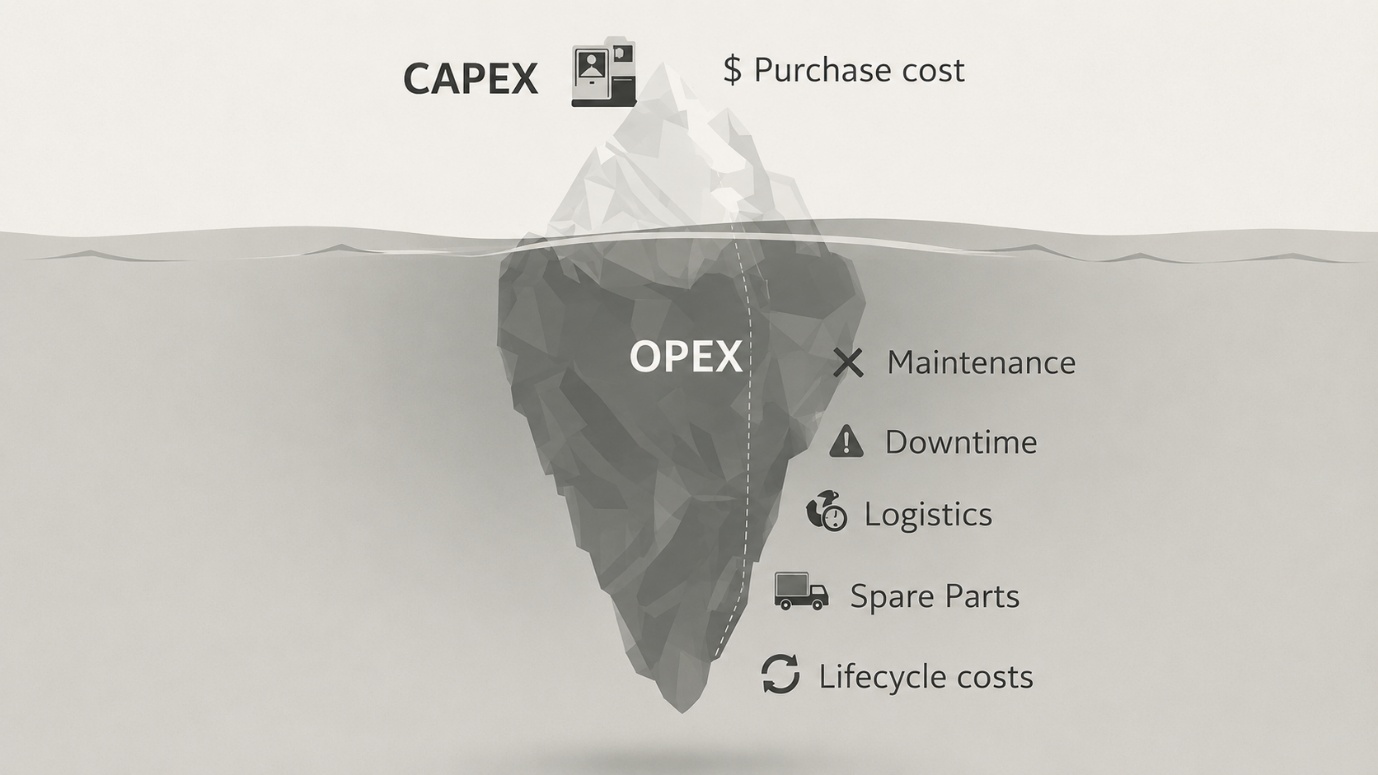
Every major engineering program discusses lifecycle cost.
Acquisition strategies reference it. Business cases acknowledge it. Engineering reviews consider it. Sustainment organisations plan for it. Operators eventually live with it.
Few concepts receive broader agreement.
Yet despite this consensus, long-term operational systems continue to experience familiar patterns.
Assets that appeared economical during acquisition become expensive to sustain. Availability targets become increasingly difficult to achieve. Maintenance burden exceeds original forecasts. Spare consumption grows beyond expectation. Workforce demand expands. Operational workarounds become embedded into daily practice.
By the time these consequences become visible, the original business case has long since been approved and the acquisition phase is often considered complete.
This raises an interesting question.
If organisations understand lifecycle cost so well, why do lifecycle cost problems remain so common?
The answer is rarely a lack of awareness.
More often, lifecycle performance lacks clear ownership across acquisition, sustainment, and operation.
The challenge is not analytical.
It is structural.
Systems Are Purchased Once and Paid for Repeatedly
Most major engineering decisions begin life as acquisition decisions.
Equipment is selected. Architectures are approved. Suppliers are contracted. Design baselines are established. Capital expenditure is authorised through governance processes intended to balance performance, schedule, risk, and affordability.
This process is both necessary and rational.
Large infrastructure, defence, mining, maritime, rail, and energy programs cannot proceed without disciplined capital approval mechanisms.
The difficulty is that acquisition represents only a brief phase within the life of an operational system.
The asset may be purchased once.
Its consequences are experienced continuously.
Maintenance labour, spare consumption, configuration management, logistics support, reliability growth, obsolescence management, software sustainment, operational downtime, workforce training, and asset integrity activities persist for decades after acquisition decisions have been made.
Operational systems therefore exhibit a characteristic that is easy to overlook.
The majority of lifecycle cost is often influenced before operation begins, yet experienced long after acquisition governance has concluded.
This creates a natural disconnect.
Those responsible for approving capital investment are not always the same people responsible for sustaining operational performance throughout the life of the asset.
The system itself experiences no such distinction.
The organisational structure does.
Capital Efficiency and Lifecycle Efficiency Are Different Objectives
One reason lifecycle tension persists is that capital efficiency and lifecycle efficiency are not identical objectives.
Both are important.
Neither should be dismissed.
The challenge arises when one is mistaken for the other.
Capital efficiency seeks to minimise upfront investment while achieving required capability outcomes.
Lifecycle efficiency seeks to optimise performance, resilience, availability, supportability, and cost across the full operational life of the system.
These objectives overlap but do not always align.
A component with lower acquisition cost may require significantly greater maintenance effort throughout service life.
A reduced redundancy strategy may improve affordability during acquisition while increasing operational risk exposure.
A commercially available subsystem may simplify procurement while introducing sustainment constraints under more demanding operational conditions.
A deferred reliability improvement may preserve schedule and budget objectives while increasing future maintenance burden.
None of these decisions are inherently wrong.
The issue is that their consequences emerge in different phases of the lifecycle.
Acquisition frameworks naturally prioritise acquisition outcomes.
Operational systems ultimately reveal lifecycle outcomes.
The distinction becomes important because organisational structures often reinforce phase-based optimisation.
Programs optimise delivery.
Sustainment organisations optimise support.
Operations optimise availability.
Finance optimises expenditure.
Each function performs its role competently.
The challenge emerges in the space between them.
The Original Purpose of Lifecycle Analysis
The engineering profession recognised this problem decades ago.
Many lifecycle engineering disciplines were created specifically to bridge the gap between design decisions and operational consequence.
Reliability engineering sought to understand long-term failure behaviour.
Maintainability analysis examined repair burden and support effort.
Logistic Support Analysis was developed to translate design choices into manpower requirements, spare demand, maintenance workload, tooling needs, and sustainment consequence.
Availability modelling attempted to connect reliability and maintainability assumptions to operational outcomes.
The underlying objective was straightforward.
Create visibility.
Allow decision-makers to understand the future consequences of current engineering choices.
Provide mechanisms through which lifecycle performance could influence design rather than merely document it.
The intent remains valid.
The difficulty is that lifecycle analysis only creates value when it changes decisions.
When lifecycle activities become procedural obligations rather than decision inputs, their influence diminishes substantially.
Reports are generated.
Models are completed.
Data is collected.
The acquisition decision proceeds largely unchanged.
The analysis exists.
The decision architecture remains unaffected.
In these circumstances, lifecycle engineering risks becoming observational rather than influential.
The capability to identify future consequence exists, but the organisational mechanisms required to act upon that information remain weak.
Lifecycle Cost Emerges Through Interaction
One of the more persistent misconceptions surrounding lifecycle cost is the assumption that it can be understood through isolated decisions.
In reality, lifecycle cost behaves much like operational availability.
It emerges through interaction.
A reliability assumption influences spare demand.
Spare demand influences inventory exposure.
Inventory exposure influences logistics cost.
Maintenance accessibility influences labour requirements.
Labour requirements influence workforce structure.
Workforce structure influences operational availability.
Availability influences utilisation patterns.
Utilisation influences degradation behaviour.
The relationships are continuous.
No individual decision creates lifecycle cost independently.
Lifecycle cost emerges from the combined behaviour of the system across time.
This is why local optimisation frequently produces unexpected downstream consequences.
Each decision may remain entirely rational within its immediate context.
Collectively, however, they create a system whose behaviour differs from what any individual stakeholder anticipated.
The issue is not technical failure.
It is systems interaction.
Lifecycle consequence accumulates at the interfaces between decisions.
Acquisition and Sustainment Are Organisational Boundaries
Operational systems do not recognise the distinction between acquisition and sustainment.
Organisations do.
To the system, there is only one continuous lifecycle.
The design decision that influences maintenance burden fifteen years later remains part of the same causal chain.
The spare provisioning assumption that affects availability a decade after delivery remains connected to the original engineering logic.
The asset itself experiences continuity.
The organisation experiences phases.
This distinction matters because organisational boundaries often create artificial discontinuities in accountability.
Acquisition teams are measured against delivery objectives.
Sustainment organisations inherit the resulting support burden.
Operators absorb availability outcomes.
Each group manages a different phase.
No single group necessarily owns the total consequence.
As a result, lifecycle optimisation becomes difficult even when everyone agrees it is important.
The challenge is not intent.
The challenge is ownership.
Without end-to-end accountability, decisions naturally optimise local objectives rather than lifecycle outcomes.
The system eventually reconciles those decisions through operational reality.
Usually at significantly higher cost than would have been required earlier in the lifecycle.
Engineering Governance and Lifecycle Intelligence
This is where engineering governance becomes particularly important.
Governance is often viewed as a mechanism for approval, assurance, compliance, and risk management.
Those functions matter.
However, its deeper purpose is maintaining coherence across decisions whose consequences emerge over long time horizons.
Effective lifecycle governance creates continuity between acquisition assumptions, operational evidence, and sustainment reality.
It preserves visibility between engineering decisions and operational consequence.
It ensures lifecycle analysis remains connected to decision-making rather than isolated within supporting documentation.
Most importantly, it creates pathways through which future operational considerations can influence present engineering choices.
Without these mechanisms, lifecycle intelligence remains fragmented.
Engineering teams generate insights.
Reliability practitioners identify risks.
Sustainment specialists recognise emerging burdens.
Operators observe practical limitations.
Yet the information remains distributed across organisational boundaries without sufficient integration.
The knowledge exists.
The system struggles to act on it coherently.
This is fundamentally a governance challenge rather than a technical one.
The Question Beneath Every Business Case
Many discussions about lifecycle cost focus on analytical techniques.
Better models.
Improved forecasting.
More accurate cost estimation.
Enhanced lifecycle assessment methodologies.
These are valuable capabilities.
But they do not address the underlying issue.
The more important question is simpler.
Who owns lifecycle performance?
Not acquisition performance.
Not sustainment performance.
Not operational performance.
Lifecycle performance.
Who remains accountable for the relationship between design decisions, reliability assumptions, maintenance burden, operational availability, workforce demand, and cost consequences across the full life of the system?
In many organisations, the answer is unclear.
And that uncertainty explains much of the gap between lifecycle understanding and lifecycle outcomes.
Systems Reveal Their True Cost Over Time
Engineering systems possess a characteristic that governance frameworks sometimes underestimate.
They are patient.
A system can appear successful during acquisition while accumulating sustainment burden beneath the surface. It can meet approval thresholds while embedding future maintenance challenges. It can satisfy requirements while creating operational inefficiencies that emerge only after years of service.
Eventually, however, the system reveals the consequences of its design.
Maintenance demand rises.
Availability declines.
Workforce requirements increase.
Spare consumption grows.
Operational complexity expands.
The asset begins telling the story that the acquisition phase could only partially see.
This is why lifecycle thinking is ultimately a systems discipline rather than a financial discipline.
The objective is not simply understanding cost.
It is understanding consequence.
Complex operational systems continuously convert engineering decisions into operational realities across decades of service.
The most successful organisations recognise that this process does not occur within acquisition, sustainment, or operations independently.
It occurs across all of them simultaneously.
Because lifecycle cost problems rarely emerge because organisations fail to understand CAPEX and OPEX.
They emerge because lifecycle performance often has no natural owner.
And when ownership becomes fragmented, systems inevitably optimise phases instead of lifecycles.
The consequences may take years to appear.
But operational systems are remarkably effective at revealing them eventually.