When sustainment performance starts to deteriorate, attention naturally turns to the organisations responsible for supporting the asset.
Maintenance performance is examined.
Spare parts availability is questioned.
Supply chains are reviewed.
Contractor performance is scrutinised.
Workforce capacity is investigated.
These are reasonable places to look, because this is where the consequences become visible. Downtime increases. Maintenance backlogs grow. Spares demand exceeds forecasts. Repair times lengthen. Operational availability declines.
But where a problem becomes visible is not necessarily where it began.
Many sustainment problems begin years earlier, while the system is still being defined, designed and acquired.
The economics make this significant. Analyses of major Defence systems, including those by the US Government Accountability Office, commonly find that operating and support costs make up the majority of total lifecycle cost, often cited as around 70 per cent. Most of that expenditure is incurred in sustainment, but much of it is determined well before sustainment begins.
Sustainment Begins Before the Asset Exists
A persistent misconception in complex programs is that sustainment begins after delivery. In this model, engineering develops the system, acquisition delivers it, operations uses it and the sustainment organisation keeps it running.
Organisationally, those responsibilities may be separate. Technically, they cannot be.
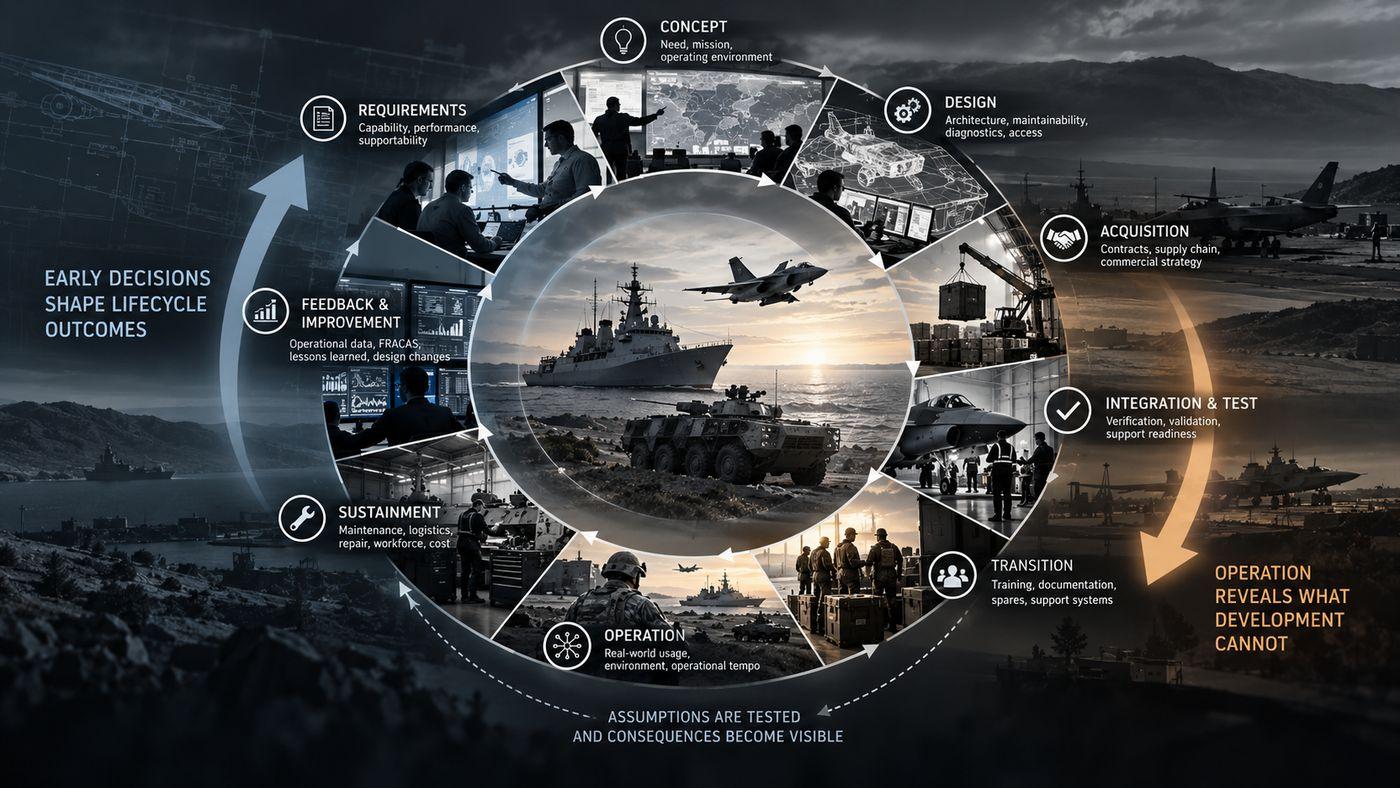
A system's future sustainment performance is shaped, step by step, through decisions made during:
- business and mission analysis;
- requirements definition;
- architecture development;
- technology and equipment selection;
- detailed design;
- acquisition and contracting;
- integration, verification and validation; and
- transition into service.
By the time the asset reaches the sustainment organisation, many of the variables that determine its supportability are already fixed.
The physical architecture exists. Equipment access has been decided. Diagnostic capability has been built in, or left out. Levels of repair have been shaped by equipment design. Supply arrangements are in place. Support equipment and training requirements have emerged. Technology choices have created future obsolescence exposure.
The sustainment organisation inherits these characteristics. It can optimise within them, but changing them may be difficult, disruptive and expensive.
Economists call this path dependence: early choices, often made for good reasons at the time, narrow the set of options available later and lock a system onto a particular trajectory. Paul David's study of the QWERTY keyboard is the classic illustration. Sustainment organisations live with path dependence every day. They inherit trajectories they did not choose.
Design Decisions Become Sustainment Conditions
Consider something as apparently simple as equipment placement.
During design, packaging may be optimised to reduce space, weight or structural complexity, and the design objective may be achieved. But if a routinely replaced component can only be reached after removing several other assemblies, that packaging decision has also created a maintenance consequence.
The same principle applies throughout the system:
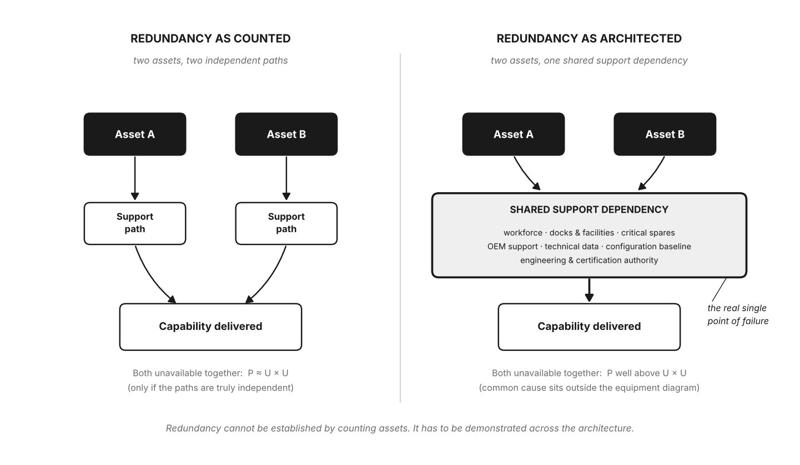
- Architecture influences redundancy and fault tolerance.
- Modularity influences replacement strategy.
- Instrumentation and testability influence fault detection and isolation.
- Component selection influences reliability and spares demand.
- Technology selection influences obsolescence.
- Standardisation influences inventory and training complexity.
- Physical access influences maintenance duration.
Diagnostics show this especially clearly. Fault detection rate, fault isolation rate and false alarm rate are set largely by built-in test design and sensor placement. When they fall short, the result in service is longer troubleshooting, unnecessary removals and high no-fault-found rates. All of these show up as sustainment cost, but they began as design decisions.
These are design characteristics. They are also sustainment characteristics. The distinction exists mainly on the organisation chart. The asset experiences them as one system.
Maintainability Cannot Be Added Later
This is especially true of maintainability.
Once the physical architecture has matured, the opportunities to improve maintainability shrink rapidly.
Improving access during concept or preliminary design may only require moving equipment or changing a layout.
Improving the same access problem after production may require redesign, structural modification, new documentation, configuration changes, further verification and fleet-wide embodiment.
The technical problem is the same. The cost and difficulty of fixing it are not.
This pattern is well documented across engineering fields. Barry Boehm's widely cited work on the cost of change in software development found that defects corrected late in the lifecycle cost many times more to fix than those caught early. Physical systems behave similarly, and often more severely, because a late change has to be embodied in hardware, not just code.
Maintainability cannot simply be handed to the sustainment phase. It needs to influence architecture while the architecture can still change. Questions such as:
How will this item be accessed?
How will the failure be detected and isolated?
What has to be removed before this component can be replaced?
What personnel, tools and facilities will be required?
How quickly can capability be restored?
are design questions as much as maintenance questions.
Support Concepts Are Built on Assumptions
Physical design is only part of the picture. Sustainment systems are also built on assumptions.
Reliability predictions assume particular operating conditions.
Maintenance concepts assume particular failure behaviour.
Workforce models assume personnel numbers and competency.
Provisioning models assume failure demand and replenishment times.
Supply chain strategies assume lead times and supplier availability.
Lifecycle cost models assume future utilisation and expenditure.
None of this is a problem in itself. Future operating conditions can't be known perfectly, and engineering needs assumptions.
The risk emerges when assumptions become built into the support solution without staying visible as assumptions.
A predicted utilisation rate gradually comes to be treated as fact.
An estimated repair time becomes a planning constant.
A provisional logistics delay becomes embedded in an availability model.
An assumed workforce profile becomes the basis of a support organisation.
Years later, the operating environment changes, but the support system is still built around the original assumptions.
A planning assumption has become a lifecycle constraint.
Operations Reveal What Development Cannot
Development programs can test extensively. Designs can be verified, reliability predicted, maintainability demonstrated, support concepts analysed and operational scenarios simulated.
But no development program can perfectly reproduce years of service.
Operation brings duration, variability and combinations of conditions that are hard to replicate beforehand. Equipment accumulates operating hours. Environmental exposure varies. Personnel change. Supply chains face genuine demand. Configurations evolve. Operational tempo shifts. Assumptions that were independent start to interact.
Some failure behaviour simply can't appear early. Wear-out mechanisms, which in Weibull terms have a shape parameter greater than one, only become visible once components have built up enough operating time. That is typically far longer than any development test program provides. A system can therefore pass every development test while carrying wear-out modes that will dominate its sustainment burden later in life.
In this sense, operation provides a form of continuing validation. It shows whether the assumptions set during development still represent reality.
The operational environment does not necessarily create the underlying sustainment problem. Often, it reveals a vulnerability that was already built into the system.
The Lifecycle Accountability Gap
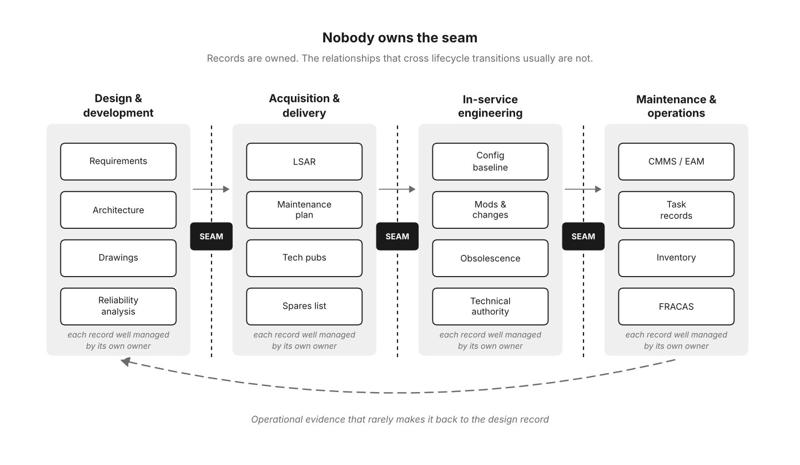
This creates an important governance problem. The people experiencing a sustainment consequence may be organisationally separated from those who made the decision that caused it.
A design team makes an architectural decision. Years later, maintenance inherits the access constraint.
Acquisition chooses a particular commercial arrangement. Years later, supply chain teams manage the dependency.
A program accepts reduced diagnostic capability. Years later, technicians spend longer isolating faults.
A project makes a schedule-driven trade-off. Years later, operations absorbs the availability consequence.
No single decision need reflect poor judgement. The problem is that decision authority and lifecycle consequence can become separated by organisational boundaries and by time.
Economists would recognise this as an externality: a cost created by one party and borne by another, outside the decision that produced it. When the acquisition phase does not bear sustainment costs, those costs are not fully weighed when acquisition decisions are made. Organisations can therefore transfer risk downstream without clearly recognising that a transfer has occurred.
Integrated Product Support Must Influence Design
This is where Integrated Product Support becomes especially important.
IPS should not simply document how an already-designed system will be supported. Its greater value comes from influencing the system while meaningful design choices are still available. Within Logistic Support Analysis frameworks such as DEF(AUST)5692, the analytical tools for doing this are well established:
- Reliability analysis identifies expected failure demand.
- Maintainability analysis identifies restoration constraints.
- Maintenance Task Analysis exposes resource, access and support equipment requirements.
- Level of Repair Analysis informs repair architecture.
- Supply support analysis identifies logistics dependencies.
- Training analysis exposes workforce implications.
- Lifecycle costing reveals the long-term economic consequences of design alternatives.
Used early, these disciplines shape engineering decisions. Used late, they mainly describe the consequences of decisions already made.
That is a fundamentally different value proposition.
The Cost of Late Discovery
Sustainment problems can often be corrected after the system enters service. A component can be relocated, diagnostics improved, procedures rewritten, spares purchased, support equipment introduced, contracts changed or engineering modifications implemented.
But late correction carries a premium. These interventions may require redesign, certification, configuration management, new training, documentation updates, procurement and implementation across an entire fleet or asset base.
The organisation is no longer influencing the design.
It is paying to overcome the design.
That is why early lifecycle influence matters. The aim is not to predict every sustainment problem before operation. That is unrealistic. The aim is to identify decisions with significant lifecycle consequences while they are still economically and technically changeable.
Close the Loop After Entry Into Service
Designing for sustainment does not mean the work finishes at delivery. The assumptions set during development must keep being tested against operational evidence.
Observed failure behaviour should challenge reliability predictions.
Actual repair durations should challenge maintainability assumptions.
Spares demand should challenge provisioning models.
Maintenance outcomes should challenge task effectiveness.
Operational utilisation should challenge the original mission profile.
Supply performance should challenge logistics assumptions.
FRACAS and operational data should therefore feed back into engineering, maintenance and support decisions. The lifecycle relationship should be continuous:
Design → Predict → Support → Operate → Observe → Learn → Improve
Sustainment is both an outcome of earlier engineering and a source of evidence for future engineering, including the next generation of the capability.
Design the Supportable System
Strong sustainment outcomes do not begin with an efficient maintenance organisation. They begin with a system designed to be supported.
That requires engineering, acquisition, operations and IPS disciplines to consider lifecycle consequences before architecture and commercial arrangements become hard to change. It requires assumptions to stay visible. It requires sustainment evidence to influence design. And it requires decision-makers to understand who will inherit the consequences of today's trade-offs.
Maintenance organisations and logistics systems remain essential. But they work within conditions created throughout the lifecycle.
The most useful question is therefore not simply:
How will we sustain the system once it enters service?
It is:
What are we designing today that the sustainment organisation will have to live with tomorrow?
Many sustainment problems are discovered in service.
But their foundations were laid much earlier.
Aerion Engineering Advisory
Aerion Engineering Advisory helps organisations integrate reliability, maintainability and Integrated Product Support into engineering decisions before lifecycle constraints become difficult and expensive to change.
Our approach connects RAM, FMEA/FMECA, RCM, Maintenance Task Analysis, Level of Repair Analysis, supportability analysis, lifecycle cost and operational evidence with systems engineering and design. We help organisations develop capabilities that are not only technically effective, but supportable throughout their intended lifecycle.