In golf, a player does not use every club in the bag.
But they carry them.
Conditions change. The wind shifts, lies vary, and distance is uncertain. The skill is not simply in having the equipment. It lies in reading the situation well enough to select the right club, and then using it well.
Complex engineering programs face a very similar challenge.
Reliability, Availability and Maintainability (RAM) analysis, Reliability-Centred Maintenance (RCM), Failure Modes and Effects Analysis (FMEA), its criticality-based extension FMECA, and Failure Reporting, Analysis and Corrective Action Systems (FRACAS) are well-established methods for understanding and managing lifecycle risk. Each has a mature body of practice behind it. FMEA and FMECA are codified in standards such as IEC 60812 and the long-standing MIL-STD-1629A. RCM traces its origins to Nowlan and Heap's 1978 work in commercial aviation and is now framed by criteria such as SAE JA1011. RAM and FRACAS sit within the broader dependability management frameworks described in the IEC 60300 series.
Yet none of these methods, individually or collectively, constitutes a lifecycle strategy.
They are tools. Having every tool available does not, by itself, mean the underlying risk is being managed.
The Comfort of the Toolkit
Large Defence, infrastructure, transport, energy and other asset-intensive programs are rarely short of analytical capability.
RAM models forecast reliability and availability. FMEA and FMECA identify failure modes and characterise their consequences. RCM derives maintenance strategies from those consequences. FRACAS captures in-service failures and drives corrective action. Each brings structure, traceability and evidence to engineering decision-making, and each, properly applied, is valuable.
The difficulty arises when completing the analysis becomes the objective in its own right.
A RAM model may be produced because the contract requires a RAM assessment. An FMEA may be completed because it appears in the systems engineering management plan. RCM workshops may be held because a maintenance program must be delivered by a particular milestone. In each case, the deliverable satisfies a requirement. Whether it answers a meaningful question is a separate matter.
This is a familiar pattern in organisational behaviour. When a measure becomes a target, it tends to lose its value as a measure. The existence of analytical activity creates a sense of assurance, and that assurance can stand in for actual understanding of lifecycle exposure.
But an analysis is only as useful as the problem it has been asked to investigate.
If the question is narrow, the answer will be narrow.
If the assumptions are optimistic, the forecast will be optimistic.
If the system boundary is poorly defined, the analysis may carefully optimise the wrong part of the system.
Before selecting a method, programs therefore need to ask a more fundamental question:
What lifecycle exposure are we actually trying to understand or reduce?
Tools Cannot Correct a Poorly Framed Problem
Every analytical method works within a defined boundary, and each has epistemic limits. It can only reason about what has been placed in front of it. A few examples show how this plays out.
An FMEA can systematically identify how an item or function might fail and assess the effects of each failure mode. It cannot reverse an architectural decision that has placed a frequently failing component somewhere physically difficult to access. The analysis may record the poor maintainability accurately, but by the time it is performed, the decision that caused it has often already been taken.
RCM can determine technically appropriate and worthwhile maintenance tasks and intervals. It cannot make up for poor diagnostic coverage or limited testability designed into the system years earlier. If a hidden failure cannot be detected because no suitable test point exists, the RCM logic will correctly point to a failure-finding task. The underlying weakness, however, remains a design deficiency, not a maintenance problem.
A RAM model can predict inherent and operational availability against an assumed operational profile. It cannot determine that the profile itself is unrealistic unless those assumptions are explicitly challenged and later validated against real usage. A model built on a benign duty cycle will produce a confident but misleading result if the asset is then operated far more intensively.
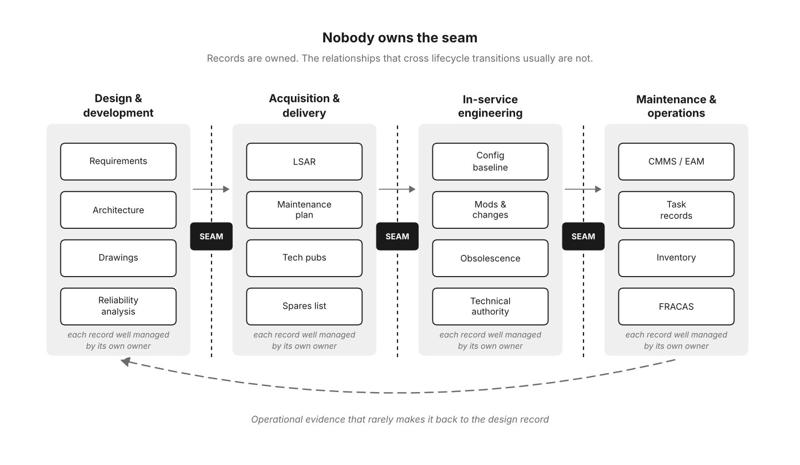
FRACAS can provide strong evidence about how a system actually fails in service. But if that evidence does not flow back into reliability models, maintenance policy, engineering change, configuration management and future design decisions, FRACAS becomes a reporting system rather than the engine of reliability growth it was designed to be.
In none of these cases has the method necessarily failed. The problem lies outside the boundary within which the method was applied. This distinction matters, because the usual response to disappointing in-service performance is to call for more analysis, when the real gap lies in how the problem was framed in the first place.
Lifecycle Risk Often Begins Upstream
A large share of sustainment problems can be traced to decisions made much earlier in the capability lifecycle. The commonly cited heuristic is that most lifecycle cost is committed during concept and design, even though most of it is spent during operation and support.
Maintainability can be constrained by architecture.
Reliability can be affected by environmental assumptions.
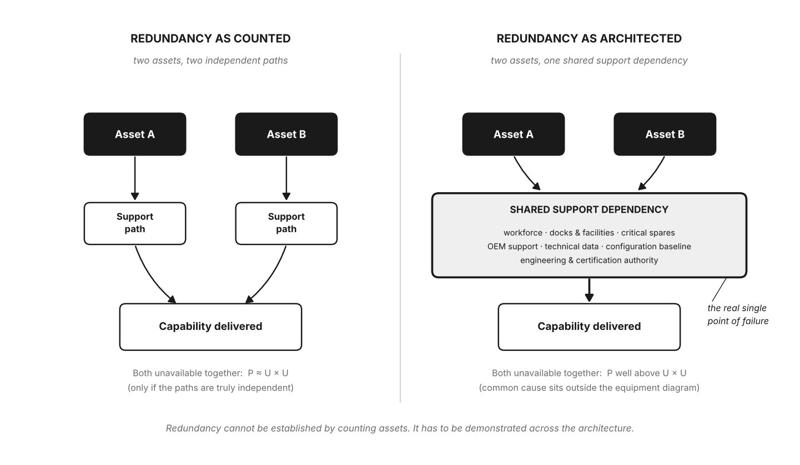
Availability can be undermined by logistics delay, workforce limits, spares policy or maintenance capacity, none of which a component-level reliability prediction captures.
Support costs can become locked in through design decisions long before an asset enters service.
It follows that lifecycle engineering has to shape decisions while those decisions can still be changed. This is the logic behind Logistic Support Analysis and Integrated Product Support frameworks, including those set out in DEF(AUST)5692. Their purpose is to bring supportability into design trade-offs, not to document the consequences once those trade-offs have been settled.
Before asking which analysis to perform, engineering teams should be able to answer the following:
- Where is lifecycle risk entering the system?
- Which assumptions have the greatest influence on the predicted outcome?
- Which design decisions could create long-term reliability, maintainability or supportability consequences?
- Which trade-offs are turning short-term acquisition savings into long-term ownership costs?
- What evidence would show that current assumptions are wrong?
- Who has the authority to act when the analysis identifies a problem?
The last question is often the most revealing. An analysis that points to a design deficiency is only useful if someone has both the mandate and the means to respond to it.
Once these questions have been answered, choosing the right engineering method becomes fairly straightforward. Without that clarity, organisations can carry out a great deal of analytical work while leaving the underlying exposure largely unchanged.
RAM Should Be a Living Engineering Model
RAM shows this particularly clearly.
It is often treated mainly as an acquisition activity: develop the model, demonstrate compliance, meet the requirement, baseline the design. Once the design review is passed, the model is archived with the rest of the program documentation.
But a RAM model is fundamentally a prediction built on assumptions. These include failure distributions, mean times to repair, operating environments, utilisation rates, maintenance concepts, logistics delay times and system configuration. Each assumption carries uncertainty, and the combined effect of those uncertainties on predicted availability is often larger than programs acknowledge.
Once the system enters service, evidence starts to replace assumption.
Actual failure rates become observable.
Real repair durations can be measured.
Operational profiles become clearer.
Logistics delays emerge.
Maintenance practices evolve.
Configuration changes.
At that point, the original RAM model becomes more valuable, not less, provided it is maintained. It becomes a means of comparing predicted with observed performance, and of identifying where, and why, the system is departing from expectation. In statistical terms, the program now has the data to update its prior beliefs about system behaviour, rather than continuing to rely on them.
This creates a continuous engineering loop:
Predict → Observe → Compare → Understand → Correct → Recalculate
FRACAS data, maintenance records, operational usage and configuration information can steadily refine the model and support better decisions across the asset's life. RAM should therefore not be seen simply as evidence that a system met an availability requirement at one design review. It should become part of the organisation's ongoing understanding of how its systems actually perform.
From Analysis to Decision Support
This shifts the role of lifecycle engineering.
The aim is no longer simply to produce RAM analyses, FMEAs, RCM studies or FRACAS reports. The aim is to use those methods to improve engineering and sustainment decisions.
Sometimes the right response will be a design change.
Sometimes it will be a revised maintenance task or interval.
Sometimes it will mean additional spares, better diagnostics, different workforce arrangements or changes to the operating concept.
And sometimes the analysis will show that the most effective intervention lies somewhere quite different from where the organisation expected. The availability shortfall blamed on component reliability may turn out to be driven by supply chain delay. The maintenance burden attributed to poor procedures may originate in a packaging decision made during detailed design.
That is exactly why the problem must come before the method. An organisation that starts with the method will usually find answers within that method's domain. An organisation that starts with the problem is free to find the answer wherever it actually lies.
Clarity Before Method
To return to the golf analogy, carrying more clubs does not automatically improve the round.
The player has to understand the lie, the distance, the wind and the cost of getting the shot wrong before choosing a club. A well-chosen club, played with intent, will usually beat a full bag used without judgement.
Lifecycle engineering works the same way.
RAM, RCM, FMEA, FMECA and FRACAS provide powerful analytical capability. But they are not the strategy.
The strategy is understanding where lifecycle risk enters the system, deciding which risks matter, selecting the right engineering intervention, and continually testing assumptions against evidence as the system moves through its lifecycle.
The toolkit supports that process.
It does not replace it.
erion Engineering Advisory
Aerion Engineering Advisory helps organisations understand and manage reliability, availability, maintainability and supportability risk across the engineering lifecycle.
Our approach connects RAM, FMEA/FMECA, RCM, FRACAS and Integrated Product Support with the engineering decisions they are meant to inform, helping organisations move from analytical compliance towards evidence-based lifecycle decision-making.