Few major engineering programs suffer from a lack of reviews.
Design reviews are held. Safety assessments are completed. Reliability and maintainability analyses are presented. Requirements are verified. Risks are reviewed. Actions are closed. Technical maturity progresses through established governance gates.
Yet systems can still enter service with availability shortfalls, sustainment problems, integration issues and lifecycle costs well beyond those anticipated.
This raises an important engineering governance question:
How can a project pass through its reviews successfully while still struggling to achieve the operational outcomes those reviews were meant to protect?
One explanation is that engineering reviews can gradually start optimising the wrong thing. They become good at demonstrating evidence of compliance, and less good at testing whether uncertainty about future system performance has actually been reduced.
The accounting scholar Michael Power described a similar pattern in The Audit Society. Verification processes can become what he called rituals of verification: they produce organisational comfort through the visible completion of checks, rather than through any real gain in understanding. Engineering reviews are not immune to the same drift.
What Is an Engineering Review Actually For?
Engineering reviews exist to support decisions under uncertainty.
Whether a review concerns architecture, detailed design, reliability, safety, maintainability, supportability or operational readiness, its basic purpose should be the same:
To determine whether sufficient evidence and understanding exist to justify the next decision.
That distinction matters. The objective is not simply to prove that engineering work has happened. It is to understand what that work has taught us about the system.
A good review challenges assumptions. It exposes interactions that have not been properly considered. It identifies uncertainty hidden within apparently mature analysis. It tests whether predicted behaviour is still credible. And it helps decision-makers understand the consequences of proceeding.
The value of a review therefore lies not mainly in the evidence presented, but in the quality of judgement that evidence makes possible.
When Compliance Becomes the Objective
Formal governance inevitably needs evidence. Requirements must be traced, analyses completed, risks identified, verification evidence produced, actions resolved and configuration controlled. These activities are necessary.
The problem begins when completing them becomes a proxy for understanding.
A project can show that:
- the RAM model has been completed;
- FMEA/FMECA has been performed;
- requirements have been allocated and verified;
- risks have been documented;
- review actions have been closed; and
- the required documents have been approved.
Every statement may be true. But none, on its own, shows that the organisation understands how the system will behave in service.
Completion is evidence of activity. It is not necessarily evidence of reduced uncertainty.
Once a proxy is used as a target, people naturally start optimising the proxy. Review criteria written as checklists of deliverables reward the production of deliverables. They do not necessarily reward the uncomfortable work of finding out what those deliverables fail to show.
The Difference Between Maturity and Understanding
As programs progress, they naturally look more mature. Documentation becomes more detailed, models more sophisticated, requirements more stable, and risk registers more complete. That progression creates confidence, usually with good reason.
But technical maturity and uncertainty reduction are not the same thing.
A mature reliability model may still depend heavily on an assumed operating profile.
A completed maintainability analysis may rely on repair durations never demonstrated under representative conditions.
A mature support concept may depend on workforce or logistics assumptions that have not been stress-tested.
A verified subsystem may still behave unexpectedly when integrated with other subsystems.
A compliant design may meet its documented requirements while producing lifecycle consequences those requirements never captured.
The integration point has a technical parallel. Technology Readiness Levels measure the maturity of individual technologies, but research on system readiness has shown that mature components do not guarantee a mature system. This led to complementary measures such as Integration Readiness Levels. Readiness is a property of the whole, not just the parts.
Psychology offers a further explanation. Daniel Kahneman showed that confidence tends to track the coherence of the story we are told rather than the quality of the evidence behind it. A well-organised, thoroughly documented program tells a very coherent story. The project can therefore grow more confident while some of its most consequential assumptions remain uncertain.
That is the confidence gap engineering governance must detect.
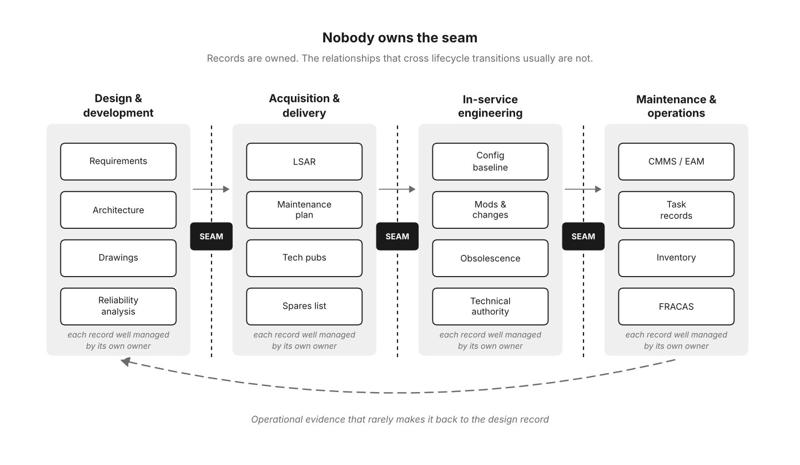
The Most Important Risks Often Exist Between Disciplines
Engineering reviews are commonly organised by specialist discipline. Reliability specialists review reliability. Safety specialists review safety. Systems engineers review requirements and architecture. Supportability specialists review support concepts. Project management reviews schedule and cost.
Each discipline brings essential expertise. But complex systems do not experience these disciplines separately. Operational outcomes emerge from their interaction.
A design decision intended to improve reliability may increase maintenance burden.
A schedule recovery decision may reduce the depth of verification.
A procurement decision that lowers acquisition cost may increase sustainment cost.
A configuration change may improve one subsystem while creating dependencies elsewhere.
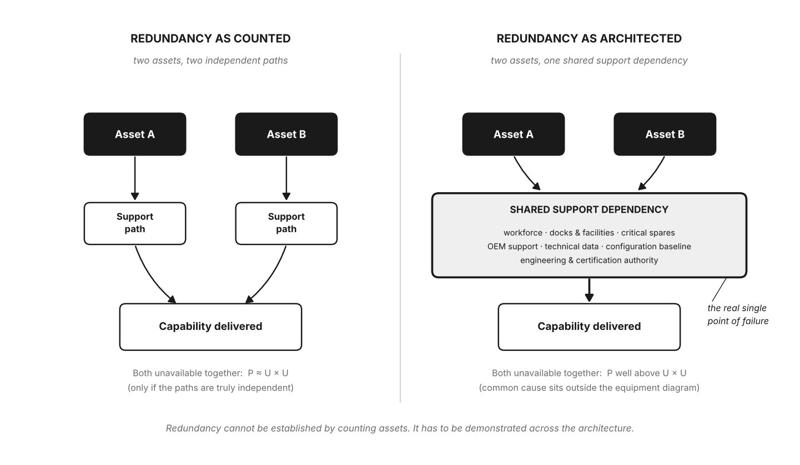
Within its own boundary, each decision may be reasonable. At system level, their combined effect may move the capability away from its intended outcome.
This is why local optimisation cannot be assumed to produce system optimisation. The most consequential engineering risks often sit at interfaces, boundaries and assumptions, exactly where individual discipline reviews have the least visibility.
Ask a Different Question
Many engineering reviews focus on questions such as: Has the analysis been completed? Have the requirements been met? Have the actions been closed? Has the risk been treated?
These questions matter. But they should lead to a more important one:
How has this work improved our confidence in future operational performance?
That question changes the nature of the review. Suppose a reliability analysis has been completed. Rather than simply asking whether the model meets the requirement, the review can ask:
- Which assumptions dominate the result?
- How sensitive is the prediction to those assumptions?
- Which assumptions have been demonstrated, and which are still estimates?
- What evidence would cause us to change our conclusion?
- What happens if utilisation differs materially from the assumed profile?
These are, in effect, requests for sensitivity analysis. A tornado diagram showing which inputs drive a RAM prediction often tells a review board more than the prediction itself. The same principle applies to maintainability, supportability, safety, integration and lifecycle cost.
The review shifts from confirming that an activity took place to understanding what has actually been learned.
Evidence Is Not the Same as Knowledge
This distinction becomes more important as programs generate more engineering information. More evidence can create more confidence, but more information does not automatically mean more understanding.
A program may have hundreds of requirements, extensive modelling, mature risk registers and substantial verification evidence, while still carrying significant uncertainty around a handful of assumptions that dominate operational performance. These may concern utilisation, environmental severity, failure behaviour, repair duration, logistics delay, workforce availability, integration dependencies or supply chain performance.
A thousand pages of supporting evidence do not make up for one critical assumption that has never been properly challenged.
Decision theory gives this idea a precise form: the value of information. Evidence is valuable to the extent that it could change the decision. Evidence that confirms what is already well understood adds little. Evidence that resolves a dominant uncertainty can be worth more than everything else combined.
Engineering governance should therefore distinguish between evidence volume and evidence value. The important question is not how much evidence exists. It is whether the evidence materially changes what decision-makers know about the risk they are accepting.
Reviews Should Expose Assumptions
One of the most valuable outcomes of an engineering review is making assumptions visible.
Every predictive engineering activity depends on them. Reliability models assume operating environments and utilisation. Availability models assume repair and logistics performance. Lifecycle costing assumes future expenditure profiles. Support analysis assumes workforce, facilities and supply arrangements.
Assumptions are not a problem in themselves. Hidden assumptions are.
A strong review should therefore ask:
What must be true for this conclusion to remain valid?
That question can be extraordinarily powerful. It exposes the dependencies behind confident engineering conclusions, and lets the organisation decide which assumptions need verification, monitoring, contingency or explicit risk acceptance.
Engineering Reviews Are Decision Points, Not Documentation Events
This changes how review success should be measured.
A successful review is not necessarily one where every action is closed. Nor is it necessarily one where the project receives approval to proceed.
Sometimes the most valuable review is the one that slows a decision down. It might narrow the scope of an approval, require a specific assumption to be demonstrated before the next gate, or make residual uncertainty explicit so that it is accepted knowingly rather than inherited by accident.
A review that approves progress with a clear statement of what remains uncertain, who owns that uncertainty, and what evidence will resolve it has done its job. A review that approves progress because every box is ticked may simply have postponed the discovery.
What a Better Review Looks Like
In practice, reviews optimised for understanding tend to share a few characteristics:
- Entry and success criteria framed around uncertainty, not just deliverables. For example: "The dominant assumptions in the availability prediction have been identified, and their sensitivity is understood."
- An explicit assumptions register, recording which assumptions are demonstrated, estimated or untested, and who owns each.
- Cross-discipline challenge, where reliability, supportability, safety and design examine each other's assumptions, not only their own.
- Deliberate adversarial techniques, such as Gary Klein's pre-mortem: imagine the system has failed to meet its availability target in service, then work backwards to explain why.
- Decisions recorded with their residual uncertainty, so that risk accepted at one gate is visible at the next, and in service.
None of this requires more reviews. It requires reviews that ask better questions.
Optimise for Understanding
Engineering reviews are among the most powerful tools a program has. They bring together expertise, evidence and authority at the moments when decisions matter most.
But their value depends on what they are optimised for. Reviews built to confirm completion will, over time, become very good at confirming completion. Reviews built to reduce uncertainty will become good at finding what the program does not yet know.
A project can pass every gate and still be surprised in service.
The purpose of a review is not to prove that the work is done. It is to discover what the work has not yet told us.
Aerion Engineering Advisory
Aerion Engineering Advisory helps organisations strengthen engineering governance so that reviews, gates and technical assurance processes improve decision quality, not just compliance.
Our approach connects RAM, FMEA/FMECA, RCM, supportability and lifecycle analysis with the assumptions and decisions that determine operational outcomes, helping organisations identify the uncertainties that matter before they become in-service surprises.