If you work outside Defence or aerospace, the terms Integrated Logistics Support (ILS) and Integrated Product Support (IPS) may mean very little.
The problem they are trying to solve should not.
Every complex capability depends on more than the asset performing the primary function.
An aircraft depends on maintenance, supply, ground support, training, engineering, software, technical information and configuration management.
A warship depends on dockyard infrastructure, engineering support, supply chains, workforce capability, technical data and configuration control.
A mine, railway, processing plant or energy facility depends on equivalent systems, organised under different names.
The terminology changes. The systems problem does not.
The asset and the systems needed to operate, maintain, support, modify and recover it must ultimately function as one integrated whole.
Start With the System of Interest
Engineering organisations naturally focus on the system performing the primary function: the aircraft, the vessel, the vehicle, the production plant, the generating asset.
The questions are familiar. What must it do? What performance must it achieve? What environments must it withstand? Is it safe? Is it reliable? Does it meet its requirements?
These questions are fundamental. But they are not sufficient.
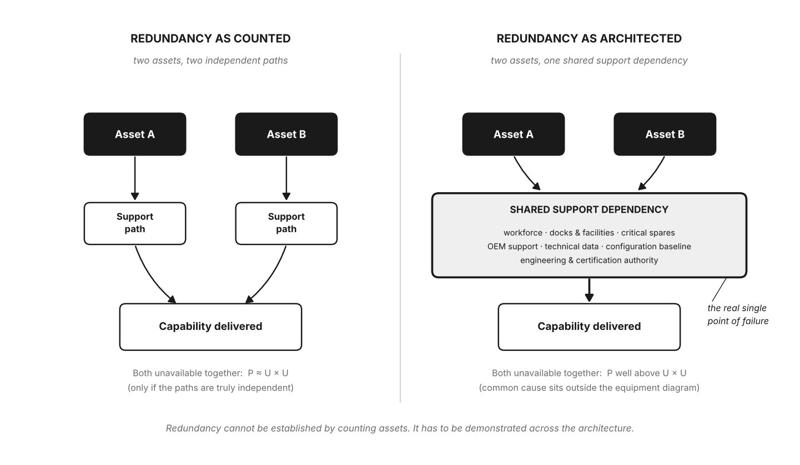
No complex asset operates independently of the systems around it. If the engineering boundary stops at the physical boundary of the equipment, everything outside that boundary has effectively been handed to someone else.
The system itself does not recognise that organisational distinction.
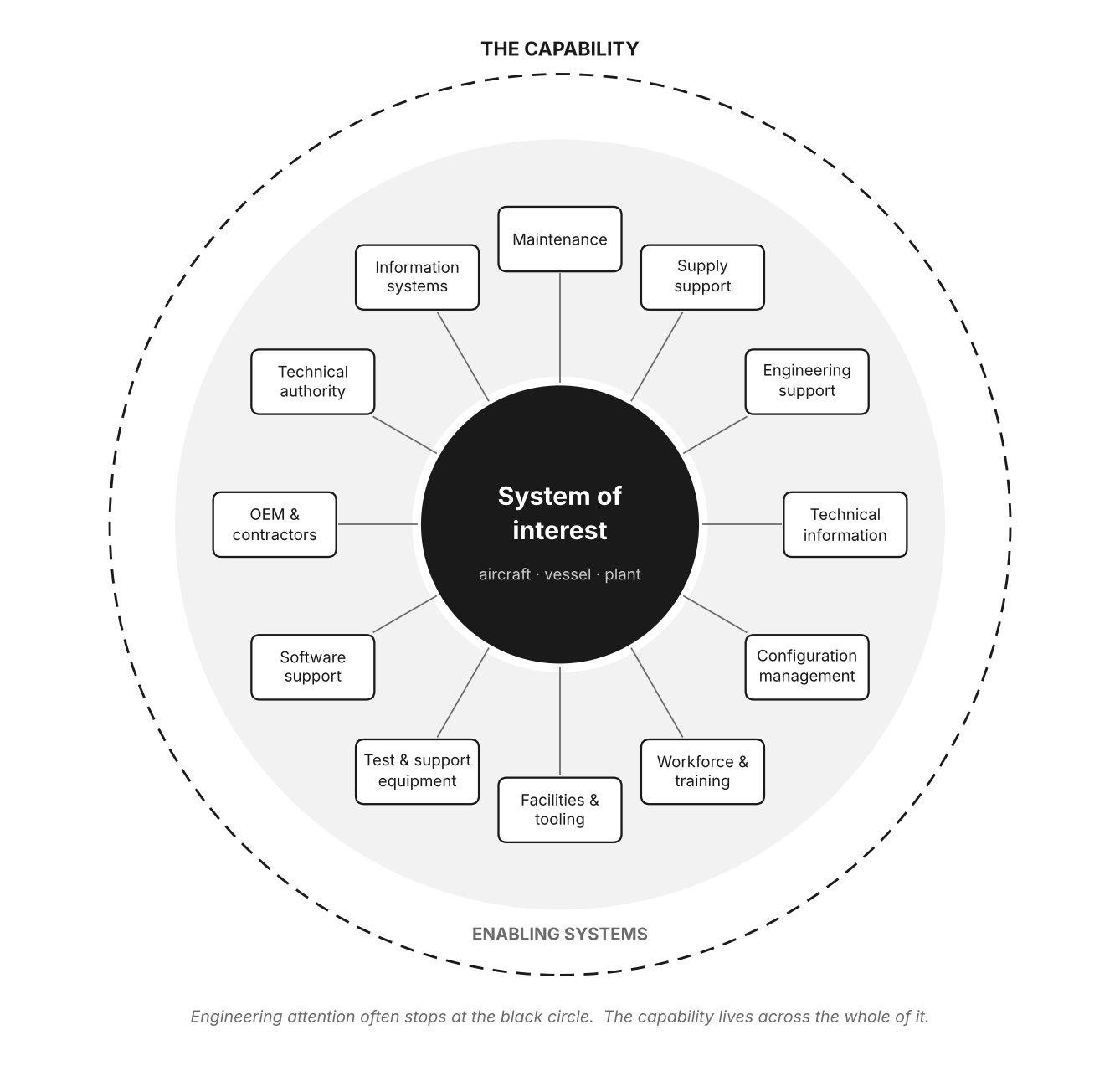
Systems engineering has precise language for this. ISO/IEC/IEEE 15288, the international standard for system lifecycle processes, distinguishes the system of interest from its enabling systems. Enabling systems support the system of interest throughout its lifecycle, without necessarily contributing directly to its function in operation. Maintenance, supply, training, test equipment and engineering support are enabling systems in exactly this sense. The standard treats them as part of the systems engineering problem, not as an afterthought to it.
Systems Engineering Must Provide the Backbone
Systems engineering provides the framework for looking beyond the equipment. It asks what outcome the system must deliver, which functions are needed, how those functions interact, what external systems are required, which interfaces must be managed, and what is being assumed about the operating environment.
That makes supportability and sustainment part of the systems problem. Not something added after it.
If an architecture does not properly consider how the system will be operated, maintained, diagnosed, repaired, supplied, trained, modified and eventually disposed of, then it describes only part of the lifecycle system.
It may describe the product extremely well. It does not necessarily describe the capability needed to keep that product effective throughout its intended life.
The Product Is Only Part of the Capability
Around every complex asset sits a network of enabling systems. These may include maintenance, supply support, engineering support, technical information, configuration management, workforce and training, facilities and tooling, test and support equipment, software support, information systems, OEM and contractor support, logistics networks, and governance and technical authorities.
[Insert diagram: ips-enabling-systems.jpg]
It is tempting to represent these as support functions surrounding the asset. That framing can be misleading. They are not peripheral services. They are part of the overall system needed to produce the intended operational outcome.
Remove competent maintainers, and availability falls.
Remove configuration integrity, and engineering decisions become uncertain.
Remove accurate technical information, and maintenance becomes unreliable.
Remove supply support, and repairable equipment stays unavailable.
Remove engineering authority, and technical problems cannot be resolved.
The physical asset may still meet its design specification. The capability does not.
Australian Defence has long recognised this at the capability level. Its Fundamental Inputs to Capability treat major systems as only one input, alongside personnel, organisation, collective training, facilities, supplies, support, command and management, and industry. Defence contracting draws a similar line between the Mission System and the Support System. The principle is already embedded in policy. The challenge is making it real in engineering decisions.
Where IPS Actually Fits
This is where Integrated Product Support needs to be understood carefully.
IPS is not simply a new name for logistics. Nor should ILS be caricatured as only ever being about spares, maintenance manuals and downstream support. Properly applied, ILS has always sought to influence design, improve supportability and bring lifecycle considerations in early enough to affect engineering decisions.
The move to IPS makes the broader lifecycle responsibility more explicit. In the United States, the shift was formalised when the Department of Defense replaced the traditional ten ILS elements with twelve IPS elements, and legislation required major weapon programs to appoint a dedicated Product Support Manager accountable for lifecycle support outcomes. The change in vocabulary came with a change in accountability.
It shifts the emphasis from:
Have we delivered the required support products?
towards:
Have we engineered a capability that can actually be operated and sustained throughout its intended lifecycle?
Those questions sound similar. They create very different behaviours.
The first can drift towards deliverables and compliance. The second requires engineering judgement.
Design the Product and the Enabling Systems Together
The traditional sequence of:
Design → Build → Deliver → Support
creates a structural problem. By the time the physical system is substantially designed, many sustainment outcomes may already be set.
Maintenance access has been fixed by the physical architecture.
Diagnostic capability has been built into the design.
Component choices have shaped supply chain exposure.
System architecture has affected levels of repair.
Interfaces have created tooling and test equipment requirements.
Technology choices have created workforce and training requirements.
Software architecture has created future support dependencies.
Configuration complexity has shaped the technical information and change management burden.
These decisions may be made before the organisation formally starts discussing the support solution. By then, IPS is no longer influencing the architecture. It is designing support around it.
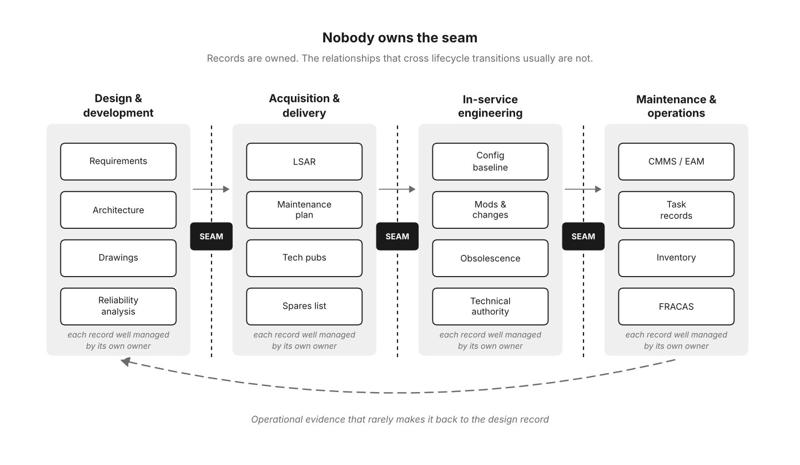
A stronger lifecycle model develops the product and its enabling systems concurrently. Operational need drives requirements. Requirements drive architecture. Architecture considers both the primary system and the systems needed to enable it. Supportability analysis informs design while the design can still change. Operational evidence then feeds back into both the product and the enabling systems throughout service.
This is the logic of concurrent engineering, applied across the whole lifecycle rather than only to design and manufacture. It is not about creating a bigger process. It is about changing when lifecycle knowledge is allowed to influence decisions.
The Organisation Chart Is Not the System Boundary
Organisations need functional boundaries: engineering, operations, maintenance, reliability, supply, asset management, configuration management, projects, commercial management, contractors. These divisions provide expertise and accountability.
But they do not represent how the system behaves.
A design decision changes maintenance burden.
A procurement decision changes supply resilience.
A configuration decision affects technical information.
An operational decision changes reliability exposure.
A workforce decision affects restoration time.
A software change affects training, configuration, diagnostics and technical support.
An engineering change can propagate at once into spares, maintenance tasks, publications, tooling and lifecycle cost.
The organisation sees separate functions.
The system experiences their combined effect.
That is why lifecycle integration cannot depend only on each function performing well independently. The interactions between them must also be engineered.
IPS Is an Integration Discipline
This is perhaps the most important distinction. IPS should not be understood mainly as the management of support deliverables. Its greater value is as an integration discipline.
It connects decisions about system architecture, reliability, maintainability, maintenance, supply, workforce, training, facilities, technical information, configuration, software, support equipment and operational performance.
Each specialist discipline keeps its technical depth. IPS does not replace reliability engineering or systems engineering. It does not replace configuration management, maintenance engineering, supply chain management or asset management. Its role is to make sure their lifecycle implications are integrated.
A useful principle follows:
Specialist capability should remain distributed, while lifecycle decision-making is integrated.
From Support Products to Engineering Evidence
This also changes how IPS information should be viewed.
An LSAR, maintenance analysis, LORA, Maintenance Task Analysis, FMECA, supportability assessment or lifecycle cost model should not exist simply because a contract requires the deliverable. Each exists to support a decision:
- Why is this maintenance task necessary?
- Why is this component repaired rather than discarded?
- Why is this spare held at this location?
- Why does this workforce competency exist?
- Why is this test equipment required?
- Why is this repair capability organic rather than contracted?
- What happens to availability if the support concept changes?
Level of Repair Analysis illustrates the point well. A LORA is fundamentally an economic and technical optimisation: for each item, it weighs the lifecycle cost of discarding, repairing at the operating level, or repairing at depot, against the availability each option delivers. The output is a set of decisions. The value lies in being able to explain, years later, why each decision was made and what would change it.
The value of the analysis is therefore not the artefact itself. It is the engineering rationale the artefact preserves. That rationale should stay connected as the configuration, operating environment and support system evolve.
Operational Evidence Must Close the Loop
Entry into service should not mark the end of IPS engineering. It should open a new source of evidence.
Actual failures become observable. Actual repair times become measurable. Actual supply delays become visible. Actual workforce constraints emerge. Actual operating environments challenge assumptions. Actual maintenance tasks reveal whether predicted support requirements were realistic.
This evidence should challenge the assumptions developed during acquisition. Where actual behaviour differs materially from prediction, the engineering baseline should respond. That creates a lifecycle loop:
Design → Predict → Support → Operate → Observe → Learn → Improve
Without that loop, IPS risks becoming a static description of the support solution as it stood at delivery. With it, IPS becomes part of continuing systems engineering.
This Is About Outcomes, Not Paperwork
The purpose of integrating the product and its enabling systems is not administrative completeness. It is performance: availability, reliability, maintainability, operational effectiveness, resilience, safety, supportability, adaptability, lifecycle cost and asset longevity.
When enabling systems are treated as part of the architecture, these outcomes can be engineered deliberately. When support runs as a parallel compliance activity, documentation can be complete while lifecycle performance stays poor.
Management research describes a parallel shift in commercial industry. Sandra Vandermerwe and Juan Rada coined the term servitization in 1988 to describe manufacturers moving from selling products to delivering outcomes. Later work on product-service systems showed how that shift changes what a supplier is accountable for. Availability-based contracts in aerospace, where engine makers are paid for hours of operation rather than for parts and repairs, are a well-known example. Once the contract is for the outcome, the supplier is suddenly very interested in the enabling systems.
That distinction matters. A capability is not supportable because its support documentation is complete. It is supportable when the whole system needed to operate and sustain it performs effectively under real conditions.
Different Industries, Same Systems Problem
Defence uses ILS and IPS terminology. Other industries organise similar responsibilities differently.
Commercial aviation combines continuing airworthiness, maintenance programs, engineering support, technical services, logistics, training and ground support.
Maritime operations depend on maintenance, configuration management, supply, engineering support, facilities, workforce and technical information.
Mining integrates asset management, reliability engineering, maintenance, operations, supply, OEM support and shutdown planning.
Oil and gas combines asset integrity, engineering, maintenance, operations, supply chain, contractors and regulatory processes.
Rail, utilities and manufacturing use different structures again.
None of them needs to adopt Defence terminology. The terminology is not the important part. The important question is whether the organisation has engineered the complete set of systems needed to deliver the intended lifecycle outcome.
The Evolution Is Responsibility
The deeper transition, then, is not:
ILS → IPS
It is:
Support Function → Integrated Lifecycle Responsibility
An organisation designing or acquiring a complex capability cannot treat sustainment as somebody else's downstream problem.
Systems engineering establishes the relationships between the system of interest, its operating environment, interoperating systems, enabling systems and lifecycle processes. IPS provides disciplined mechanisms to make sure the requirements of those enabling systems influence engineering decisions and stay integrated throughout the lifecycle.
That leads to a leadership question that method alone cannot answer:
Who is responsible for the performance of the whole system?
Not simply who owns maintenance, reliability, supply, configuration or engineering. But:
Who makes sure all of those systems keep working together to deliver the outcome the capability exists for?
That is a question of systems engineering, integration, governance, technical authority and lifecycle accountability.
A warship, aircraft, armoured vehicle, processing plant, mine, railway and energy facility may look completely different. But each depends on enabling systems without which the primary asset cannot fulfil its purpose. Different industries organise those systems differently and give them different names.
The engineering challenge remains the same.
The product and the systems needed to sustain it must be engineered as an integrated whole.
Systems engineering provides the architecture.
IPS makes sure that architecture does not stop at the boundary of the asset.
Aerion Engineering Advisory
Aerion Engineering Advisory helps organisations integrate systems engineering, RAM and Integrated Product Support so that lifecycle requirements influence engineering decisions while those decisions can still be changed.
Our approach connects system architecture, reliability, maintainability, FMEA/FMECA, RCM, Maintenance Task Analysis, LORA, supportability analysis, LSAR and operational evidence. We help organisations develop capabilities in which the product and its enabling systems are engineered as one integrated lifecycle system, rather than managed as separate technical and support activities.