Many organisations approach Asset Management as a position to fill rather than a capability to build.
The job descriptions often reveal the problem.
The Asset Manager is expected to understand engineering risk, reliability performance, maintenance strategy, operational requirements, capital planning, lifecycle cost and organisational priorities. At the same time, they are expected to coordinate multiple functions, influence senior stakeholders and improve whole-of-life asset performance.
The implied expectation is significant:
One person will unify the lifecycle.
Lifecycle integration does not happen because one individual understands every part of the system. It happens because the organisation has been designed so that the right information reaches the right decision-maker at the right time, and so that decisions in one part of the lifecycle are connected to their consequences elsewhere.
This view is not new. The ISO 55000 series frames Asset Management as a coordinated organisational activity, carried out through an asset management system: a set of interrelated policies, objectives, processes and responsibilities. The standard's language is deliberate. It describes a system, not a role.
Asset Management is therefore better understood as a system of decision-making than as the responsibility of a single job title.
The Illusion of Centralised Competence
It is understandable that organisations try to solve lifecycle integration problems by appointing a sufficiently capable individual. They look for someone experienced enough, technically credible enough, commercially aware enough, and senior enough to coordinate across organisational boundaries.
But lifecycle performance is not governed by the competence of one individual. It is governed by the interaction between multiple specialised disciplines.
Reliability engineering, maintenance optimisation, financial modelling, capital planning and operational execution each need different expertise. They draw on different information, work over different time horizons and respond to different organisational pressures.
A reliability engineer may be concerned with recurring failure mechanisms and reliability growth.
Maintenance planners may be concerned with task sequencing, workforce availability and maintenance windows.
Operations may be concerned with immediate asset availability and production or mission requirements.
Finance may be concerned with capital allocation, expenditure profiles and return on investment.
None of these perspectives is inherently wrong. Each is a reasonable response to the incentives and information available within its domain. The challenge is ensuring that decisions made within one domain take account of their consequences in others.
Expecting one Asset Manager to supply all of that specialist depth personally does not remove complexity. It simply concentrates the burden of integration in one person.
When Coordination Becomes the Architecture
The weakness of this approach becomes visible when organisational interfaces are put under strain.
An Asset Manager may identify recurring equipment failures but have little influence over engineering design standards or modification priorities.
A capital project may reduce acquisition expenditure while creating higher maintenance or support costs over the remaining asset life.
Maintenance teams may optimise preventive maintenance requirements, only to see operational pressures repeatedly override the maintenance program.
Reliability analysis may identify a dominant failure mechanism while investment decisions continue to favour other areas, because engineering evidence and capital planning are not connected.
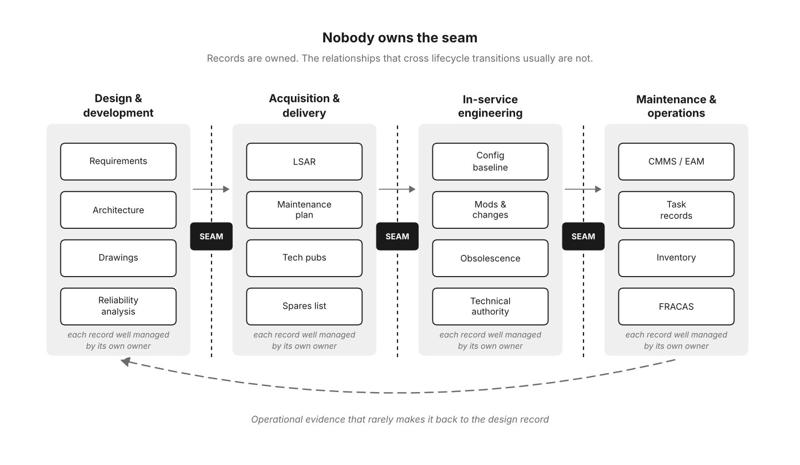
In each case, the organisation may have competent people doing competent work. The failure occurs at the interfaces.
The Asset Manager then becomes the human integration layer. They carry information between departments, reconcile competing priorities and try to create alignment through meetings, relationships and personal influence.
That can work. But it is fragile.
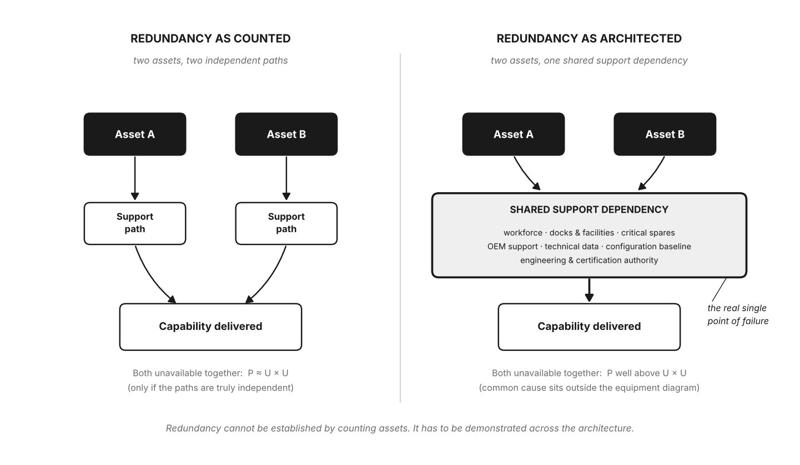
Reliability engineers will recognise the pattern immediately. An architecture in which a single component carries an essential function, with no redundancy and no defined fallback, has a single point of failure. When integration depends on one person's relationships, experience or standing, the organisation has built exactly that into its management system. If that person leaves, burns out or loses influence, the integration goes with them.
The organisation has not institutionalised Asset Management.
It has personalised it.
Technical Depth Still Matters
There is another reason Asset Management cannot simply be consolidated into a single multidisciplinary role: specialist capability needs continual reinforcement.
Reliability engineering develops through sustained work with failure data, degradation mechanisms, reliability models and corrective-action programs.
Maintenance engineering develops through repeated analysis of task effectiveness, failure consequences, inspection strategies and maintenance outcomes.
Lifecycle costing requires continuing engagement with cost structures, uncertainty, discounting assumptions and economic trade-offs.
Operational planning depends on constant exposure to real constraints: workforce, utilisation, scheduling, logistics and competing priorities.
Expertise of this kind is built, and kept, through practice. A generalist who is periodically exposed to each discipline may understand its vocabulary, but will seldom have the depth to recognise when an analysis rests on weak assumptions or when the evidence does not support a decision.
These disciplines cannot simply be represented as boxes on an Asset Management organisation chart. They need practitioners with enough depth to challenge assumptions and say when the evidence falls short.
The role of Asset Management is therefore not to replace specialist capability.
It is to connect it.
Asset Management as Organisational Architecture
A more resilient model treats Asset Management as an organisational architecture that spans the asset lifecycle.
Organisational theory has long observed that the structure of an organisation tends to shape the structure of what it produces. This idea is often summarised as Conway's Law, after its origins in software design. In Asset Management, fragmented organisational interfaces tend to produce fragmented lifecycle decisions. If the aim is integrated decision-making, the interfaces themselves have to be designed.
Within that architecture, specialist functions keep clear responsibilities.
Engineering and reliability functions provide technical understanding of asset condition, failure behaviour, design risk and opportunities for improvement.
Maintenance and planning functions turn engineering requirements into workable maintenance strategies, schedules and resource demands.
Operations provide evidence about how assets are actually used and the constraints under which they must perform.
Finance and commercial functions provide lifecycle economic discipline, investment analysis and visibility of cost consequences.
Asset Management governance connects these perspectives and makes sure competing priorities are resolved against agreed organisational objectives. ISO 55000 calls this the line of sight, linking organisational objectives through to individual asset decisions.
The precise structure will differ between industries and organisations. The principle does not:
Specialist capability should remain distributed, while lifecycle decision-making is integrated.
The Importance of Feedback Loops
The effectiveness of this model depends heavily on feedback.
Asset Management should connect what was intended during design and planning with what actually happens in operation. In systems terms, it should work as a closed-loop control system rather than an open-loop plan.
Failure data should inform reliability assumptions.
Reliability trends should inform maintenance strategy.
Maintenance outcomes should inform task intervals and resource planning.
Operational demand should inform availability modelling.
Lifecycle cost evidence should inform capital priorities.
Engineering changes should flow back into maintenance requirements, technical information, configuration baselines and support arrangements.
Together, these relationships form a continuous lifecycle feedback system.
Without them, an organisation can have excellent engineering, maintenance, finance and operations functions and still produce poor whole-of-life outcomes. Systems thinkers have long described this as sub-optimisation: each part of a system performs well against its own measures, while the system as a whole performs poorly. Each discipline optimises its own domain and unintentionally transfers cost, risk or constraints somewhere else.
Asset Management exists to stop local optimisation from turning into lifecycle underperformance.
Governance Makes Integration Repeatable
This is where governance becomes critical. ISO 55001 explicitly requires organisations to define roles, responsibilities and authorities within the asset management system, and the reason is practical. Integration that is not formally assigned will happen only by goodwill.
A mature Asset Management system should make clear:
- who owns particular lifecycle risks;
- who has the authority to make or approve decisions;
- what evidence is needed to support those decisions;
- how technical, operational and financial consequences are evaluated;
- when decisions must be escalated;
- how operational evidence feeds back into engineering and investment planning; and
- how outcomes are measured across the asset lifecycle.
These mechanisms turn integration from an informal activity into a repeatable organisational capability. They also make the system auditable. Decisions can be traced to evidence, and evidence can be traced to decisions.
The Asset Manager may still play an important coordinating role. But that person works within a system designed to enable integration, rather than being expected to create it personally.
That distinction matters.
Building Capability Rather Than Filling a Position
When lifecycle decision-making is fragmented, recruiting a more experienced Asset Manager can look like the obvious answer.
Sometimes additional capability really is needed. But recruitment alone cannot fix structural problems.
If engineering evidence does not influence investment decisions, if reliability information does not affect maintenance strategy, if operational feedback does not reach engineering, or if lifecycle ownership remains unclear, the next Asset Manager will inherit the same constraints as the last. The turnover will continue, and the organisation may wrongly conclude that it has a recruitment problem.
The more useful question is not:
Do we have the right Asset Manager?
It is:
Have we built an Asset Management system in which the right decisions can consistently be made?
That shifts attention from individual capability to organisational capability.
Sustainable lifecycle performance is rarely the product of one title. It emerges from specialist depth, clearly defined responsibilities, effective interfaces and feedback mechanisms that connect decisions across the asset lifecycle.
Asset Management is the architecture that makes those relationships work.
Aerion Engineering Advisory
Aerion Engineering Advisory helps organisations strengthen lifecycle engineering and Asset Management capability by connecting engineering evidence, reliability and maintainability analysis, support strategies and operational performance with whole-of-life decision-making.
Our focus is not simply on producing analysis, but on making sure lifecycle information supports the governance, investment and engineering decisions that determine long-term asset performance.